ABOUT e-VIM
e-VIM is an electronic thesaurus developed to facilitate the semantic mapping and exploration of metrology concepts. It has been developed by CSIR-National Physical Laboratory (CSIR-NPL), the National Metrology Institute of India, based on the Concept diagrams presented in the 3rd revised edition of the ‘International Vocabulary of Metrology – Basic and General Concepts and Associated Terms (VIM)’ which was developed by Joint Committee for Guides on Metrology / Working Group 2 (JCGM/WG2) published in 2012. The concept diagrams in the VIM provide a structured representation of the semantic relationships among metrology concepts. e-VIM builds upon these diagrams by organising the concepts into an interactive, searchable, and user-friendly electronic thesaurus.
e-VIM transforms the VIM from a static reference document into a user-friendly digital knowledge resource that enables users to easily explore, navigate, and understand metrology terminology more effectively. The tool enhances the retrieval, interpretation, and broader application of metrology terminology for both experts and newcomers to the field.
WHY e-VIM?
The International Vocabulary of Metrology (VIM) is one of the most important reference documents in metrology, serving as a common language tool for metrology experts worldwide. Given its widespread use and significance, the VIM should be digitized and made easier to navigate, aligning with the CIPM's digitalization initiatives in metrology. Converting the VIM into an electronic thesaurus will transform it from a reference document primarily used by scientists and engineers into a user-friendly knowledge resource accessible to a wider audience. It will enable users to search, retrieve, and understand metrology terms and concepts more meaningfully. Through enhanced navigation, semantic links, and interactive conceptual diagrams, users will develop a deeper understanding of the metrology conceptual framework. This will support more effective organization, retrieval, and sharing of metrology knowledge. e-VIM will also promote improved communication, and knowledge exchange.
CONVENTIONS
Notations
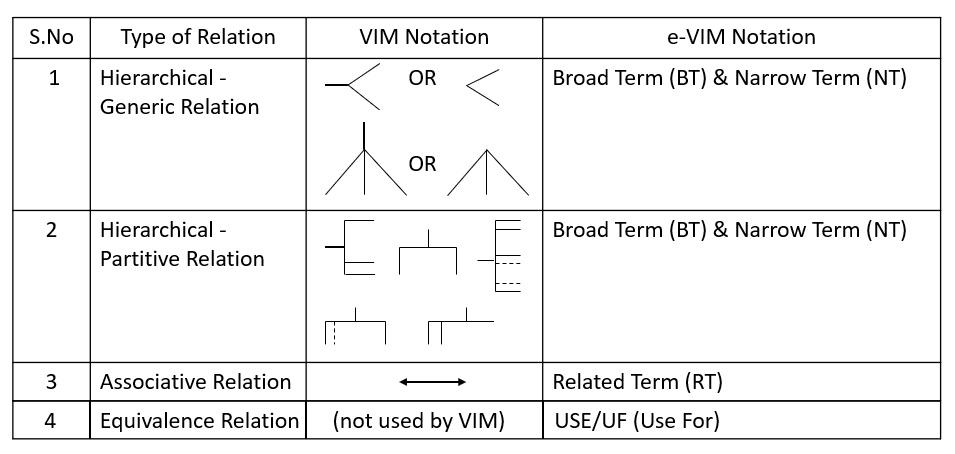
VIM has used different types of notation for making concept diagrams. The following types of relation are used by e-VIM for making the thesaurus.
Use of 'or'
Wherever in the concept diagrams 'or' is used, e-VIM connects the concepts with the associative relation 'RT'.
Reference Number
In the e-VIM, the reference numbers assigned to concepts in the VIM have not been included because they are only identification numbers and do not form part of the concepts. These numbers are used to organise the document and do not show any relationship between the terms. Also, the reference numbers may change in future editions of the VIM when new concepts are added, removed, and revised. Also, including these numbers in the thesaurus would make it difficult to update and maintain it over time. Further, users normally search for concepts or terms, not for VIM reference numbers. Therefore, excluding these numbers from the thesaurus enhances simplicity, user-friendliness, consistency, and ease of maintenance.
Parenthetic Term
A parenthetic term indicates a concept that is not defined in the vocabulary i.e. VIM, but taken as a primitive (also called non-defined concepts), which is unavoidable and assumed to be generally understood. These non-defined concepts include: system, component, phenomenon, body, substance, property, reference, experiment, examination, magnitude, material, device and signal. In e-VIM, these concepts are within brackets and represented as white nodes in a graphical format.
KEY FEATURES
Thesaurus Search
This facilitates search for metrology concepts and to explore its semantic relationships with other associated concepts. By representing concepts within a structured thesaurus framework, it facilitates expressing information in a more user-friendly manner. This allows users to build their understanding for concepts and their semantic association with other related concepts.
Network Graph
Presents the semantic relationships of any concept as an interactive node-link graph, allowing users to pan, zoom, and click to explore connected nodes/concepts. This feature facilitates navigation through the semantic conceptual network, and enhances conceptual understanding in an interactive manner.
Relationship Trail
This feature represents the chain of concepts that connect two concepts through their semantic relationships. It allows users to discover how two concepts are interconnected through both a textual trail and a visual graphical representation. This feature also helps in determining the strength of the relationship between the concepts by analysing the number of intermediate concepts (nodes) connecting them. Fewer intermediate nodes indicate a strong conceptual relationship, whereas a larger number of nodes suggests a weaker association.
Frequency Dashboard
This feature provides statistical information about the e-VIM, helping users to understand its overall structure and the level of interconnection between concepts. It includes the following:
1. Term & Relationship Count: Displays the total number of unique terms available in the thesaurus, the overall number of relationships connecting these concepts, and a detailed count of each type of relationship. This gives an overview of how the knowledge base is organised.
2. Term Frequency Count: It shows how frequently each concept is connected with other concepts in the thesaurus in ascending and descending order. This helps to identify the most highly connected and significant concepts in the domain.
This document is reproduced with the permission of the JCGM, which retains full internationally protected copyright on the design and content of this document and on the JCGM's titles, slogans and logos. The memeber organizations of the JCGM also retain full internationally protected right on their titles,slogans and logos included in the JCGM's publications. The only official versions are the original versions of the documents published by the JCGM.